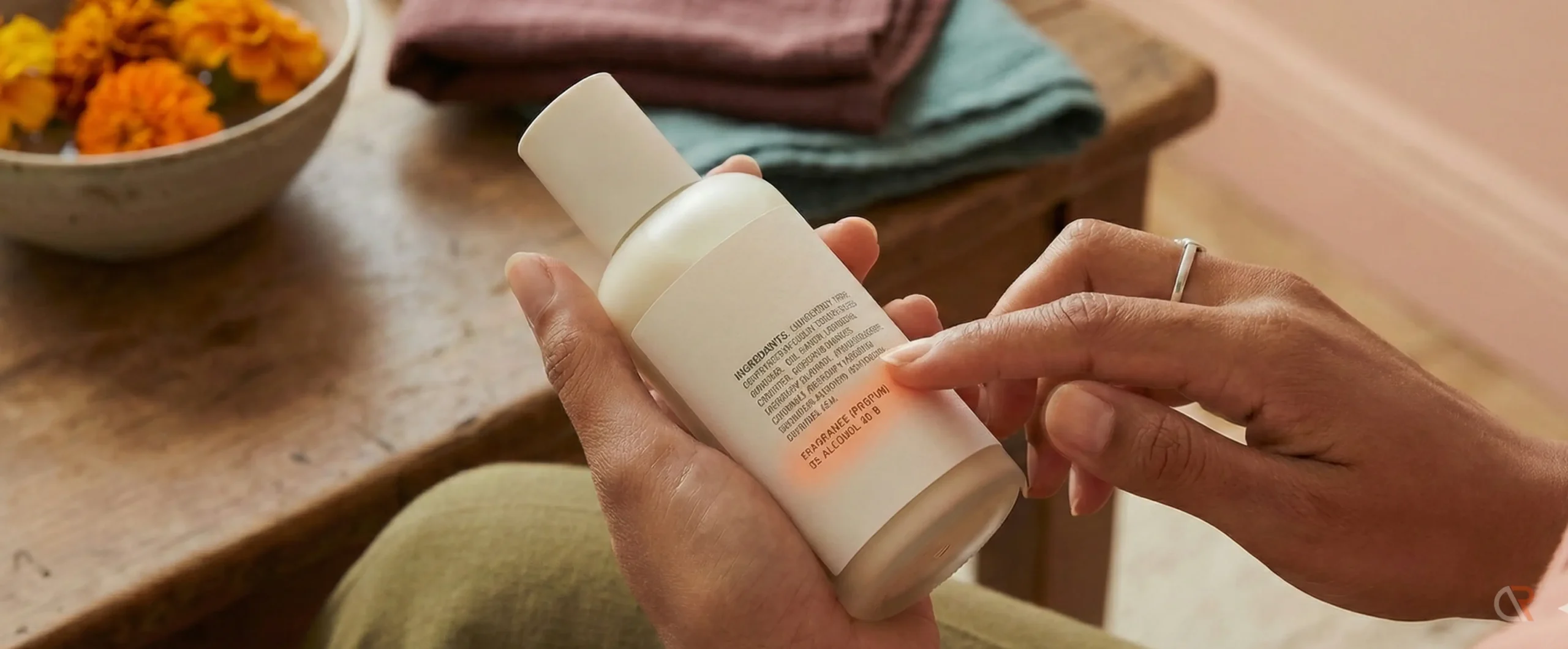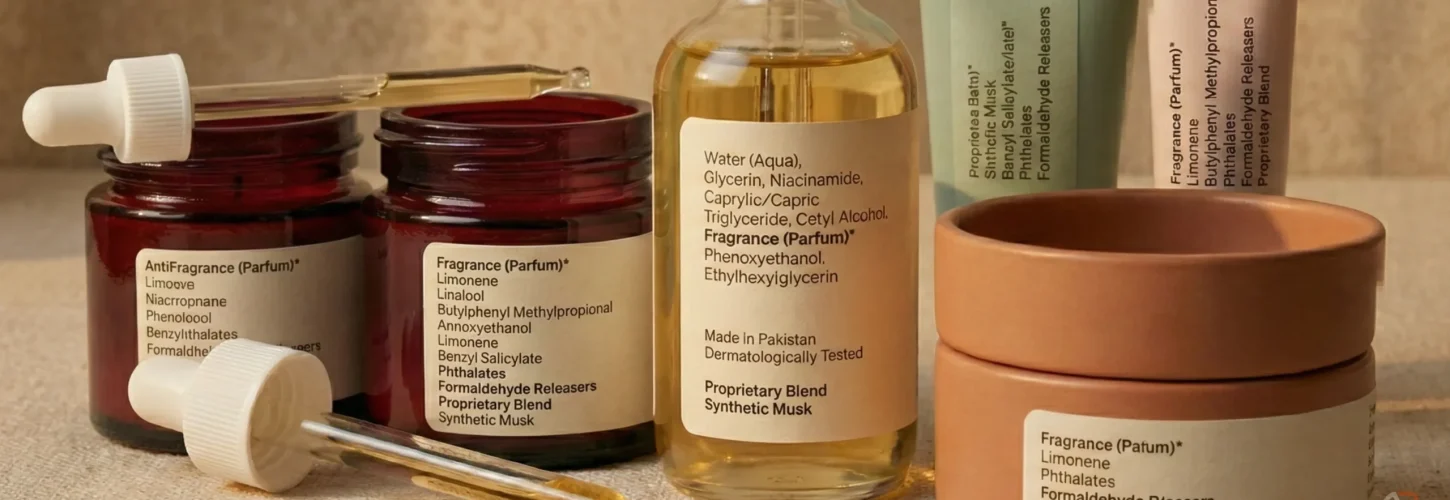
In skincare, the word “fragrance” does not mean a single ingredient.
Instead, it refers to a legally protected blend that can contain dozens — sometimes hundreds — of undisclosed chemicals. Because of regulatory loopholes, these chemicals stay hidden under one umbrella term. As a result, this matters deeply for sensitive skin and long-term exposure.
Why This One Word Deserves Your Attention
Most people scan skincare labels looking for red flags.
Parabens. Alcohol. Sulfates.
However, one word often slips by unnoticed.
Fragrance.
At first, it sounds harmless. Even pleasant. In fact, it feels optional — like something added only to make a product smell nice.
Yet here’s the truth most people aren’t told:
“Fragrance” is not one ingredient. It is a legal category.
And under that single word, brands can legally hide 100 or more individual chemicals — without listing them, explaining them, or testing them on your specific skin type.
Because of this, the issue matters if you’ve ever dealt with eczema, acne, burning, itching, headaches, or unexplained reactions. Moreover, it matters from a public health perspective, since repeated low-level exposure accumulates over time.
So let’s break this down — calmly, scientifically, and clearly.
No scare tactics. Just facts.
What Does “Fragrance” Actually Mean in Skincare?
From a chemistry standpoint, fragrance refers to a complex mixture of aroma chemicals designed to create a specific scent profile.
From a legal standpoint, however, fragrance functions as a trade secret.
This distinction matters. Brands can list “fragrance” or “parfum” instead of naming each individual component.
Why?
Because the industry classifies fragrance formulas as intellectual property. Accordingly, brands argue that disclosure would reveal proprietary recipes.
As a result:
- A single fragrance blend may contain 10, 50, or over 100 chemicals
- These blends often include synthetic aroma compounds, solvents, preservatives, and stabilizers
- None of these components must appear individually on the label
So when you see “fragrance,” you are not seeing transparency.
Instead, you are seeing permission to simplify complexity.
How Can One Word Hide So Many Chemicals?
Fragrance creation is layered, not simple.
Perfumers build scents using:
- Top notes (what you smell first)
- Middle notes (the core scent)
- Base notes (what lingers)
Importantly, each layer may contain multiple chemicals blended to evaporate at different speeds.
Additionally, to keep these scents stable in skincare products, brands often add:
- Solvents to dissolve aroma compounds
- Fixatives to make scent last longer
- Preservatives to prevent microbial growth
Individually, these chemicals may meet safety thresholds.
Collectively, however, they create complex exposure — especially with daily use.
The Regulatory Loophole Most Consumers Don’t Know About
Here’s where public health becomes essential.
Cosmetic regulations in many regions — including the EU, the US, and markets like Pakistan that rely heavily on imported products — allow fragrance ingredients to remain undisclosed unless they appear on a specific allergen list.
Unfortunately, that list remains limited.
Which means:
- Chemicals linked to irritation may go unlisted
- Low-dose endocrine disruptors may remain undisclosed
- Sensitizers that affect only certain individuals may never appear
From a population-level view, this reflects a compromise between industry and safety.
From an individual perspective, however, it often feels like guesswork.
If your skin reacts, you’re left asking:
What exactly did my skin react to?
And more often than not, there is no clear answer.
Why Fragrance Is a Leading Cause of Skin Reactions
Dermatology consistently identifies fragrance as one of the most common causes of contact dermatitis worldwide.
This is not controversial science. Researchers have documented it clearly.
Fragrance-related reactions may include:
- Redness
- Burning or stinging
- Itching
- Dry patches
- Eczema flares
- Acne-like breakouts
What makes fragrance particularly tricky is sensitization.
You might tolerate a product for months — or even years.
Then suddenly, your skin reacts.
That doesn’t mean your skin is weak.
Instead, it means your immune system finally recognized a trigger.
The Low-Dose Exposure Problem (Why “A Little” Still Matters)
Many people assume:
“If it’s allowed, it must be safe.”
Public health doesn’t work that simply.
Most safety testing evaluates individual chemicals in isolation. However, real-life exposure comes from accumulation across:
- Daily skincare
- Body products
- Haircare
- Laundry detergents
- Air fresheners
This phenomenon is known as aggregate exposure.
Low doses, repeated daily, across multiple products — especially in children, pregnant individuals, or those with compromised skin barriers — deserve attention.
Again, this isn’t panic.
It’s risk literacy.
“Natural Fragrance” vs “Synthetic Fragrance” — A Necessary Clarification
This is where marketing often muddies the water.
- Natural fragrance may include essential oils and plant extracts
- Synthetic fragrance is created in laboratories
Here’s the uncomfortable truth:
Natural does not automatically mean gentler.
Synthetic does not automatically mean harmful.
In fact, some natural fragrance components rank among the most allergenic substances. Meanwhile, some synthetic alternatives are engineered specifically to reduce irritation.
So the real issue isn’t the source.
It’s disclosure.
What This Means for Sensitive Skin (and Parents)
If you have:
- Eczema
- Rosacea
- Acne-prone skin
- Fragrance sensitivity
- A child or teenager with reactive skin
Fragrance shifts from a luxury to a risk variable.
That doesn’t mean everyone must avoid fragrance forever.
Rather, it means you deserve informed choice — not vague labels.
How to Read Labels More Safely (Without Obsessing)
Here’s practical wisdom — not perfectionism:
- Look for “fragrance-free,” not “unscented”
- Check whether brands voluntarily disclose fragrance allergens
- Patch test new products
- Simplify routines if your skin reacts easily
- Listen to patterns, not trends
Your skin gives feedback.
And you are allowed to trust it.
Final Thoughts
Fragrance ingredients in skincare are legally undisclosed mixtures that can contain dozens to hundreds of chemicals. Because trade-secret protections limit disclosure, brands do not list individual fragrance components unless they meet specific allergen criteria. Consequently, this affects sensitive skin, cumulative exposure, and public health awareness — especially in markets dependent on imported cosmetic products.
This Isn’t About Fear. It’s About Choice.
You don’t need to throw everything away.
You don’t need perfectly “clean” routines.
What you need is clarity.
Because your skin deserves transparency — not marketing shortcuts.
Call to Action
Have you ever reacted to a product without knowing why?
If so, share your experience in the comments or join The Beauty Rebels community, where we talk about skin with honesty, science, and compassion.
Frequently Asked Question (FAQs)
Is fragrance bad for skin?
Not always. However, fragrance remains one of the most common causes of irritation and allergies, particularly in sensitive skin.
Why don’t brands list fragrance ingredients?
Because cosmetic regulations legally protect fragrance formulas as trade secrets.
How many chemicals can fragrance contain?
A single blend can include anywhere from a few dozen to over 100 individual chemicals.
Is fragrance-free skincare better?
For sensitive or reactive skin, fragrance-free products are often easier to tolerate.
What’s the difference between parfum and fragrance?
They refer to the same concept and both indicate a fragrance blend.